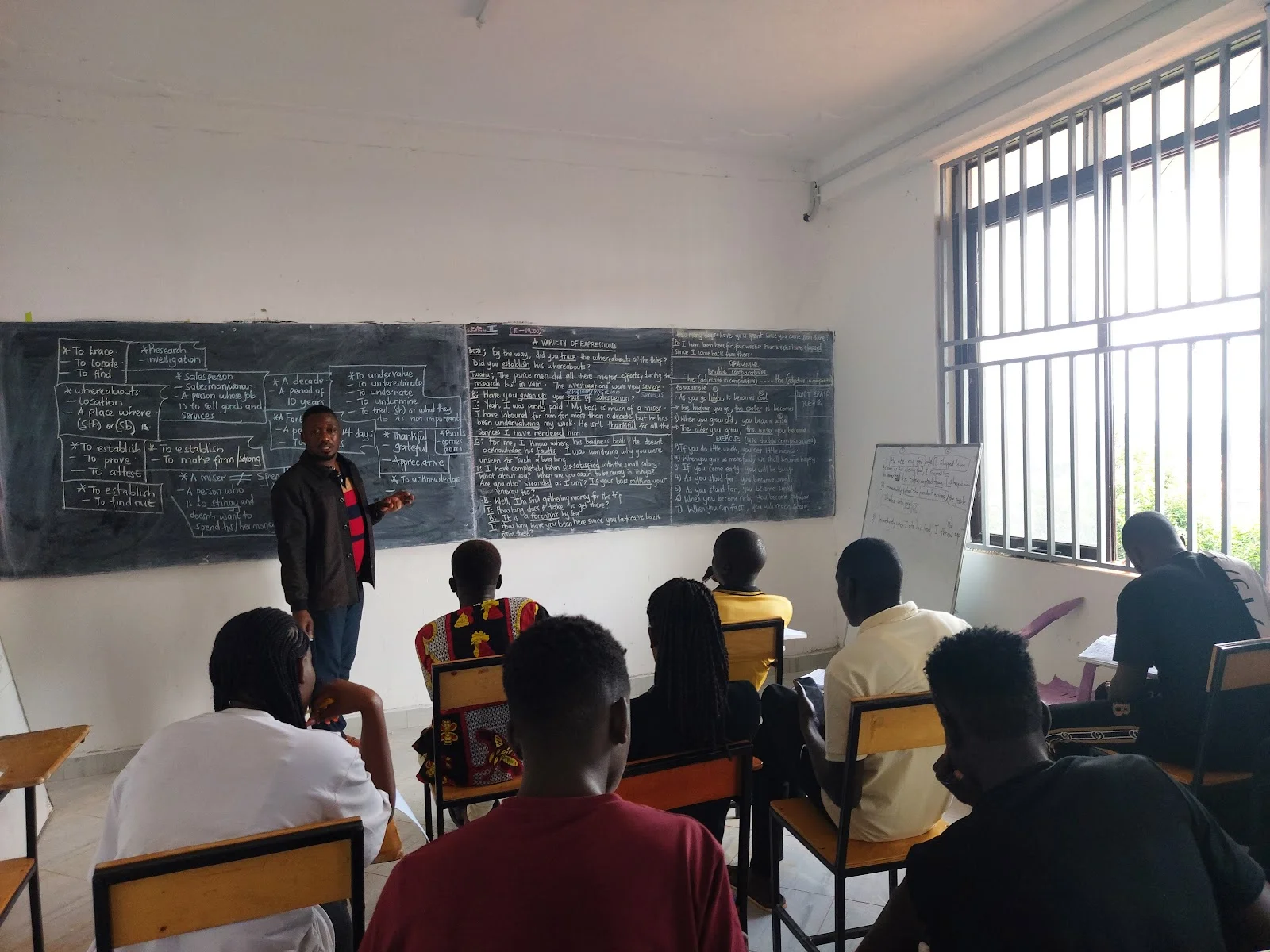



English Courses for IELTS exam preparations. For thousands of Ugandans every year, one exam stands between them and their next big step: university abroad, a job overseas, professional registration or migration to a new country. That exam is the IELTS, the International English Language Testing System. A strong IELTS score can open doors in the United Kingdom, Canada, Australia, New Zealand, Ireland and many other countries, while a disappointing result can delay plans by months.
The good news is that IELTS success is very achievable with the right preparation. In this guide, the team at Uganda Language School explains everything you need to know about English courses for IELTS exam preparation. We cover what IELTS is, the test format, band scores, how preparation courses work, what you will learn, practical tips for each section and how to choose the right course in Uganda.
What Is the IELTS Exam?
IELTS is one of the world’s most widely recognised English language proficiency tests. It measures your ability to listen, read, write and speak in English. Universities, employers, professional bodies and immigration authorities in many countries use IELTS scores to decide whether applicants have the English skills they need.
In Uganda, IELTS tests are delivered through official test partners at authorised centres, with both paper-based and computer-based options available at many locations. Always book through an official test provider and check current dates, venues and fees directly with them.
Even though English is an official language in Uganda, many Ugandans are surprised by how challenging IELTS can be. The exam tests specific skills, formats and timing that require focused preparation, which is why a dedicated IELTS preparation course makes such a difference.
IELTS Academic vs IELTS General Training
There are two main versions of IELTS, and choosing the right one is your first important decision.
IELTS Academic is for people applying to study at undergraduate or postgraduate level, or seeking professional registration, for example as doctors, nurses or pharmacists in some countries. The reading and writing tasks reflect academic contexts.
IELTS General Training is for people migrating to countries such as Canada, Australia or New Zealand, or applying for work or training programmes below degree level. The reading and writing tasks reflect everyday and workplace situations.
The Listening and Speaking sections are the same for both versions. There is also a version known as IELTS for UKVI, required for certain UK visa applications. Always check exactly which test your university, employer or immigration authority requires before booking.
Understanding the IELTS Test Format
IELTS has four sections. Listening, Reading and Writing are usually completed on the same day, while Speaking may be on the same day or within a few days before or after.
| Section | Time | What It Involves |
|---|---|---|
| Listening | About 30 minutes | 40 questions based on four recordings of conversations and talks |
| Reading | 60 minutes | 40 questions based on three or more passages |
| Writing | 60 minutes | Two tasks: Task 1 (report, chart description or letter) and Task 2 (essay) |
| Speaking | About 11–14 minutes | Face-to-face interview with an examiner in three parts |
Understanding this structure is the foundation of any good IELTS preparation course. Many candidates lose marks not because their English is weak, but because they are unfamiliar with the question types or run out of time.
How IELTS Band Scores Work
IELTS results are reported on a band scale from 0 to 9, in whole and half bands. You receive a score for each of the four sections, plus an overall band score, which is the average of the four.
- Band 9: Expert user.
- Band 8: Very good user.
- Band 7: Good user.
- Band 6: Competent user.
- Band 5: Modest user.
- Band 4 and below: Limited or extremely limited user.
Requirements vary. Many universities ask for an overall band of around 6.0 to 7.0, with minimum scores in each section, while some professional bodies require higher scores. Immigration programmes set their own requirements. Know your target score before you start preparing, because it shapes your study plan.
Why Take an English Course for IELTS Preparation?
Some candidates try to prepare alone using free materials, but a structured IELTS course offers clear advantages:
- Expert guidance: Experienced teachers know exactly what examiners look for.
- Familiarity with the format: You learn every question type and practise under timed conditions.
- Personalised feedback: Teachers correct your writing and speaking, which is almost impossible to do alone.
- Targeted improvement: Diagnostic tests identify your weakest skills so you can focus on them.
- Mock exams: Full practice tests build stamina and confidence.
- Motivation and discipline: Regular classes keep you on track.
- Saving time and money: Good preparation reduces the risk of having to retake the exam.
Learn more about English training options in our guides to the best English schools in Uganda and language training in Uganda.
Who Should Take an IELTS Preparation Course?
IELTS preparation courses suit a wide range of learners:
- Students applying to universities in the UK, Canada, Australia, the USA, Ireland and elsewhere.
- Health professionals, such as nurses, midwives, doctors and pharmacists, seeking registration abroad.
- Skilled workers applying for jobs or work visas in English-speaking countries.
- Families and individuals applying for migration or permanent residence.
- Scholarship applicants whose awards require proof of English proficiency.
- Professionals who want to measure and improve their English for career growth.
- International residents in Uganda from French-, Arabic- or other-language backgrounds who need IELTS.
What You Will Learn in an IELTS Preparation Course
A good IELTS course builds both general English ability and exam-specific skills. Typical content includes:
- A diagnostic test to measure your starting level.
- Detailed study of each IELTS section and question type.
- Grammar and vocabulary for academic and general contexts.
- Listening strategies for different accents, including British, Australian, North American and others.
- Reading techniques such as skimming, scanning and managing time.
- Writing structures for Task 1 and Task 2, with regular marked practice.
- Speaking practice with feedback on fluency, vocabulary, grammar and pronunciation.
- Timed practice tests and full mock exams.
- Test-day strategies and stress management.
IELTS Listening: How to Prepare
In the Listening section, you hear four recordings and answer 40 questions. Recordings include everyday conversations, monologues, academic discussions and lectures, with a range of English accents.
Common challenges: Unfamiliar accents, fast speech, spelling mistakes and losing concentration.
Preparation tips:
- Listen to English podcasts, news, documentaries and talks from different countries every day.
- Practise predicting answers by reading questions before each recording.
- Pay close attention to spelling, plurals and number formats, since small errors cost marks.
- Learn to recognise paraphrasing, as recordings rarely use the same words as the questions.
- Practise with official sample tests under timed conditions.
IELTS Reading: How to Prepare
The Reading section includes several passages with 40 questions in 60 minutes. Academic passages come from books, journals and newspapers, while General Training passages come from notices, advertisements, workplace documents and general-interest texts.
Common challenges: Running out of time, difficult vocabulary and tricky question types such as True/False/Not Given and matching headings.
Preparation tips:
- Read widely in English, including newspapers, magazines and academic articles.
- Practise skimming for main ideas and scanning for specific information.
- Build vocabulary, especially synonyms and academic words.
- Master each question type, including True/False/Not Given and Yes/No/Not Given.
- Do not spend too long on one question; move on and return if time allows.
IELTS Writing: How to Prepare
Writing is often the most challenging section for Ugandan candidates, and the one where expert feedback matters most.
Task 1: In IELTS Academic, you describe a graph, chart, table, map or process in at least 150 words. In General Training, you write a letter, which may be formal, semi-formal or informal.
Task 2: In both versions, you write an essay of at least 250 words responding to an argument, opinion or problem. Task 2 carries more weight than Task 1, so manage your time carefully.
Examiners assess writing on four criteria: task achievement or task response, coherence and cohesion, lexical resource and grammatical range and accuracy.
Preparation tips:
- Learn clear essay structures: introduction, body paragraphs and conclusion.
- Practise describing trends, comparisons and processes accurately for Academic Task 1.
- Learn the conventions of formal and informal letters for General Training Task 1.
- Always answer every part of the question.
- Use a range of vocabulary and sentence structures, but prioritise accuracy.
- Avoid memorised essays; examiners can recognise them.
- Get regular feedback from a qualified teacher.
IELTS Speaking: How to Prepare
The Speaking test is a face-to-face interview with a certified examiner, recorded for quality purposes. It has three parts:
- Part 1: Introduction and questions about familiar topics such as home, work, studies and hobbies.
- Part 2: A short talk on a given topic after one minute of preparation.
- Part 3: A two-way discussion of more abstract ideas linked to the Part 2 topic.
Examiners assess fluency and coherence, lexical resource, grammatical range and accuracy and pronunciation.
Preparation tips:
- Speak English every day, with friends, family or study partners.
- Extend your answers with reasons and examples, rather than giving one-word replies.
- Practise speaking for two minutes on random topics.
- Record yourself to check pronunciation, fluency and grammar.
- Do not worry about your accent; clarity matters far more.
- Stay calm and treat the test as a friendly conversation.
Types of IELTS Preparation Courses
IELTS courses come in several formats to suit different needs:
Group classes: Affordable and motivating, with the chance to practise speaking and learn from classmates.
One-to-one tuition: Fully personalised lessons focused on your specific weaknesses and target score. Ideal for candidates with tight deadlines.
Intensive courses: Daily classes over a few weeks for candidates with an exam date approaching.
Weekend and evening courses: Designed for working professionals and students.
Online IELTS classes: Live virtual lessons and digital materials for candidates anywhere in Uganda or abroad.
General English foundation courses: For learners who need to strengthen their core English before starting IELTS-specific preparation.
Explore the programmes available on our courses page, or ask about online English classes if you prefer to study from home.
How Long Does IELTS Preparation Take?
Preparation time depends on your current level, your target score and how much time you can study each week. As a rough guide:
- If you already have strong English and need to learn the format, four to six weeks of focused preparation may be enough.
- If you need to raise your score by around half a band to one band, plan for two to three months of regular study.
- If your English needs significant improvement, begin with a general English course before moving to IELTS preparation.
A diagnostic test at the start of your course gives a realistic estimate of how long you will need.
Building a Strong English Foundation First
IELTS rewards genuine English ability, not just exam tricks. If your grammar, vocabulary or fluency is weak, strengthening your general English first will make IELTS preparation faster and more effective. A solid foundation helps you understand recordings, read quickly, write accurately and speak confidently.
Our article on how much it costs to study English language in Uganda explains the options and costs for general English courses. You can also explore our dedicated English language courses.
A Sample Weekly IELTS Study Plan
Here is an example study plan for a working candidate preparing over two to three months:
- Monday: Listening practice (one full section) and vocabulary review.
- Tuesday: Reading practice (one passage, timed) and question-type review.
- Wednesday: Writing Task 1 practice with feedback.
- Thursday: Speaking practice with a partner or teacher.
- Friday: Writing Task 2 essay with feedback.
- Saturday: Class session or mock test section.
- Sunday: Rest, light reading and English entertainment such as films or podcasts.
In the final two weeks before your exam, take at least two full timed mock tests to build stamina and confidence.
Common IELTS Mistakes to Avoid
- Choosing the wrong test version, Academic instead of General Training or vice versa.
- Booking the exam too early, before you are ready.
- Ignoring weak sections and practising only what you enjoy.
- Memorising essays and speaking answers, which examiners penalise.
- Writing too few words in Writing tasks.
- Spelling and grammar errors in Listening and Reading answers.
- Poor time management in Reading and Writing.
- Not practising under exam conditions.
Learning Other Languages Alongside English
Many IELTS candidates are planning international careers where additional languages are valuable. Depending on your destination, learning French, German or another language can strengthen applications and help you settle abroad. For example, Canada values French, and German opens opportunities in Germany, Austria and Switzerland.
Explore our guides to French schools in Uganda and learning the German language. KCI Institute also offers language courses that may suit learners preparing for life abroad.
Digital Skills for Your Future Abroad
Many IELTS candidates are preparing for study or careers in competitive international environments, where digital skills are increasingly expected. Alongside English, short courses in areas such as digital marketing or coding can strengthen your CV. Uganda Language School also offers learning opportunities such as digital marketing tutoring and a beginner’s course to learn JavaScript.
Opportunities a Strong IELTS Score Can Unlock
A good IELTS result is more than a certificate; it is a key that unlocks opportunities. With the right score, you may be able to:
- Study abroad at universities and colleges in the UK, Canada, Australia, New Zealand, Ireland and beyond.
- Apply for scholarships that require proof of English proficiency.
- Register professionally as a nurse, doctor, pharmacist or other professional in countries that require IELTS.
- Apply for skilled work visas and international jobs.
- Pursue migration and permanent residence programmes.
- Advance locally with international organisations, NGOs and multinational companies in Uganda that value strong English.
Strong English also improves your prospects at home. Employers in tourism, hospitality, banking, healthcare and technology value staff who communicate confidently with international clients. Keep an eye on vacancies shared by training institutions, such as KCI Institute’s job opportunities page, and follow our blog for more language learning tips and career advice.
Staying Motivated During IELTS Preparation
Preparing for IELTS can feel demanding, especially if you are balancing work, studies or family. Set clear weekly goals, track your practice scores, celebrate improvements and remind yourself why you are taking the exam. Studying with a partner or in a class keeps you accountable, and a supportive teacher can help you stay focused when progress feels slow. Remember that every practice test brings you closer to your target band.
How to Choose the Right IELTS Course in Uganda
Before enrolling, ask these questions:
- Are the teachers experienced in IELTS preparation?
- Does the course start with a diagnostic test?
- Is there regular feedback on writing and speaking?
- Are full mock tests included?
- Which version is covered: Academic, General Training or both?
- What schedules are available: day, evening, weekend, intensive or online?
- What is the class size? Smaller classes mean more individual attention.
- What are the total costs? Ask about materials and mock tests.
Comparing institutions is always wise. For example, you can review KCI Institute’s course list, fee structure, background on the Kenlink Comprehensive Institute and its about us page.
Booking Your IELTS Exam
Once you and your teacher agree that you are ready, book your exam through an official IELTS test provider. Keep these points in mind:
- Book early, as popular dates fill quickly.
- Use the same passport or ID for booking and on test day.
- Choose between paper-based and computer-based testing; computer-based results are usually available faster.
- Check result release times and how scores will be sent to universities or employers.
- Note that IELTS results are generally accepted for around two years, though institutions set their own rules.
Always confirm current fees, dates and procedures directly with the official test provider.
Test-Day Tips
- Get a good night’s sleep and eat a healthy breakfast.
- Arrive early with your ID and booking confirmation.
- Read every instruction carefully.
- Manage your time in every section.
- In Speaking, relax, smile and speak naturally.
- Do not panic if one section feels difficult; focus on the next one.
Enrolling in an IELTS Course
- Contact the school to discuss your goals and target score.
- Take a placement or diagnostic test.
- Choose your course format: group, one-to-one, intensive, evening, weekend or online.
- Register and pay fees.
- Start classes and follow your personalised study plan.
For an example of an application process at another institution, see KCI Institute’s admissions page, online application form and student portal.
FAQ: Is IELTS Difficult for Ugandans?
Many Ugandans have a strong English foundation, but IELTS tests specific skills and formats. With focused preparation, most candidates can reach their target scores.
FAQ: Which IELTS Section Is Hardest?
Many candidates find Writing the most challenging, followed by Reading time management. Regular feedback from an experienced teacher helps most.
FAQ: Can I Prepare for IELTS Online?
Yes. Online IELTS classes offer live lessons, practice materials and feedback, making preparation possible from anywhere.
FAQ: How Many Times Can I Take IELTS?
There is generally no limit to how many times you can take IELTS, but each attempt costs money, so prepare thoroughly before booking.
FAQ: Does IELTS Expire?
Most organisations accept IELTS results for around two years from the test date.
FAQ: What Score Do I Need?
It depends on your goal. Check the exact overall and section scores required by your university, employer, professional body or immigration programme before you begin preparing.
Start Your IELTS Preparation Today
The right English course for IELTS exam preparation can transform your results and open the door to study, work and life abroad. By understanding the test format, building strong English skills, practising each section with expert feedback and taking full mock exams, you can walk into the exam room with confidence and achieve the band score you need.
At Uganda Language School, we help learners build the English skills and exam confidence they need to succeed. Learn more about us, explore our IELTS preparation course, and contact our team to book your placement test today. For further information on training options in Uganda, you can also visit KCI Institute.
Related Posts

Uganda Language Schools for English
Posted on